With Personal or Factual Tangents.
Have finished reading the sonnets. Not very well, I know: I find it so hard to get even a basic prose-level sense out of Shakespeare, and always have, that I have to admit that I’m not a very good reader at all.
I’ve always been afraid of Shakespeare, by reputation beforehand (he’s hard); (he’s too hard for you, for us), and then doing Henry V in 2nd year. I was thirteen. I knew immediately that the St. Crispin’s Day speech was a very good motivational speech, and the wooing scenes were remarkable for their bad French; but beyond that I didn’t understand any of it – who was who, why any of it was done in the first place. Or why it was important now, why this play was important now, hundreds of years and thousands of miles later, where, if I turned my eyes from the page to the window I could see the grass yellowed and strawed and dying on the hill, where we sniggered because England declared a drought if it didn’t rain for ten days straight.
My brother had Julius Caesar. At least that had a plot.
I wondered why the Bishop of Ely was important, where the cathedral was and why that seemed to be important. I wondered why about the whole thing, the colour of the book’s cover, the small print, the lines down the pages, sidenotes as well as footnotes. Looking up Ely in the encyclopedia gave factual answers about the town and cathedral, but made nothing clear. The dictionary was even more useless for this than it had been for sex, masturbation, and intercourse.
Of course the answers to those questions are that the presence of the bishop confirms the approval of the Church (the other great power in the land) for the war. The justification for the war is at the end of Henry IV Pt II. Other people have equal claim to the throne, and they’re getting restless. But you have to have seen shaky coalitions sign up to foreign adventures more than once to understand the deep and cynical realpolitik of that answer.
Hearing lectures this year on Sappho and Ezra Pound; seeing glosses on Japanese prints intermixed with translations of Horace and Catullus; 3 seeing little-known Renaissance voices translated and re-imagined in relation to each other; 4 seeing translations of Cavafy, 5 and Ritsos; 6, 7 reading a dual biography of Omar Khayyam and Edward FitzGerald, 8 I find myself revelling in a richness of education we could never have imagined. I find myself understanding how thin our education really was. We really were expected to become shop assistants and car mechanics, bank tellers and kindy teachers, faithful mothers and fathers and Mass attenders, voluminously-bearing, well-fleeced sheep.
So I’m a recognizer of superior quality, by and large, but not of all the multiple levels and layers of meaning, which Scarry and so many others are.
February 2017
Have started the Scarry book. I find I’ve clearly misread a lot of the sonnets, missed some of the kink and fury and most of the meaning – but I did get some of it right, and now, at least, the chronology is settled. Shake published them 20 years after writing them, perhaps to cheer Constable up because he was then in prison. Oh, and the bit about Marlowe: Elizabeth I condemned homosexuality; the punishment was imprisonment or execution. So “public shame” was the least of it. (Which makes Marlowe’s situation all the more...interesting. What was the deal there?)
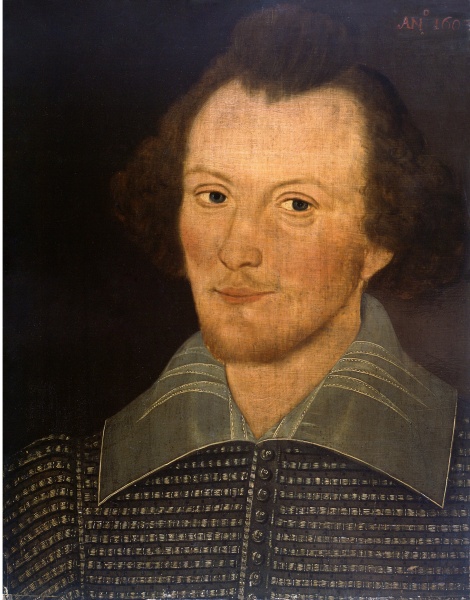
Did Kit Marlowe Guy Burgess it? – Yes and No.
Marlowe was smeared as an atheist & seditionist for political reasons. 9 When the Church and the State are combined in the same monarch, religious dissent becomes heresy becomes sedition becomes secessionist plot. His homosexuality was both real and a smear.
The unknown margin-writer in the Library’s copy of Charles Nicholl’s The Reckoning, the Murder of Christopher Marlowe, (plucked greedily off a re-cataloging truck) has seen through the layers of evidence and the contradictory first and last halves of the closing paragraphs of Nicholl’s final argument. “Oh the English!” he writes, faded blue fountain-pen ink, fascinating hand, half artist, half academic, “They will never examine the Cecils.”
The evidence Nicholl has unearthed and pieced together, and the point he makes and draws back from, is that Marlowe was very likely slated for disposal, if need be, by Robert Cecil. Marlowe’s defence in court against false accusations of seditious poster-making and pamphleteering would have revealed his years of provocateuring, in an Elizabethan street-sleaze way, for, ultimately (up, up, up through the layers), that same Robert Cecil and the Queen’s Privy Council, whose chief business had always been managing the succession. 10
Along the way, Nicholl’s book is a how-to of scams by Elizabethan grifters, who – once London was teeming and frothing with religious change and the nascent possibility of wealth, byproducts of the its defence of itself against serial European rivals, enemies and powers – set to, and invented most modern cons.
3. Merchant, Paul, Bread and Caviar, Hereford, Five Seasons Press, 2016.
4. Merchant, Paul, Some Business of Affinity, Hereford, Five Seasons Press, 2016.
5. Cavafy, Constantine, Poems 1904, tr. Paul Merchant, Portland, Tavern Books, 2016.
6. Ritsos, Yannis, Twelve Poems About Cavafy, tr. Paul Merchant, Portland, Tavern Books, 2010.
7. Ritsos, Yannis, Monochords, tr. Paul Merchant, Portland, Tavern Books, 2015.
8. Richardson, Robert D., Nearer the heart’s desire: poets of the Rubaiyat: a dual biography of Omar Khayyam and Edward FitzGerald, New York, Bloomsbury, 2016.
9. Nicholl, Charles, The Reckoning, the Murder of Christopher Marlowe, New York, Harcourt Brace, 1992.
10. See also Gregory, Philippa, The Last Tudor, New York, Touchstone, 2017.


Add comment